3D Printed Foot Holds
I set myself the challenge to design & 3D print foot holds for bouldering. Being a member of Red Spider Climbing I had a fairly decent idea of what I wanted them to look like. The design brief was:
- Reliability
In bouldering we learn to trust loading our weight onto small foot holds. I needed a foot hold that I could trust would not break under my load.
Design Considerations
In order to achieve my design spec I chose to make a low-profile hold. The further the hold comes away from the wall the more leverage is applied when a force is loaded.
For attachment to the wall I chose two 3.5mm shank screws.
I chose to use Autodesk Tinkercad to design the part since the geometry I wanted to achieve is fairly simple.

Manufacturing Considerations
I chose to print at 100% infill to make a solid part. This way the part could be finished by sanding and could be altered to achieve different angles on the top face.
I chose to print my prototypes in a material called PLA. PLA is a bioplastic derived from renewable sources such as corn or sugar cane.
Destruction Testing
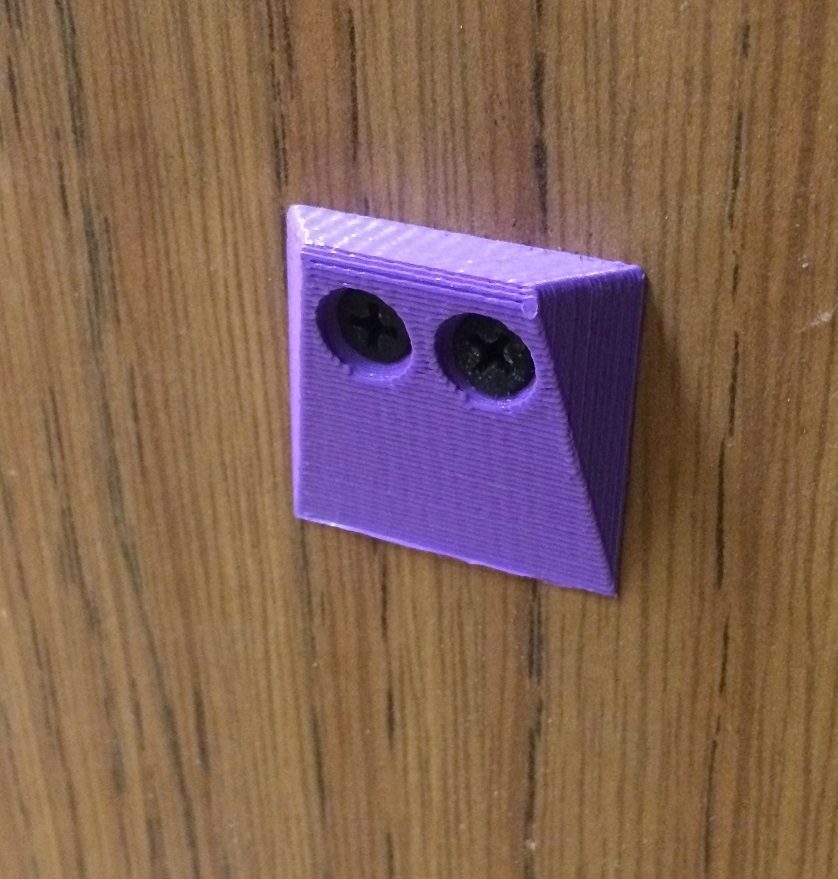
I printed a prototype hold in Amazon standard PLA and mounted to a chipboard board using 3.5mm shanked screws. Since printing in March 2020 I have loaded my weight (14 stone / 197lb) on it once a day for a full year but it’s still going strong. My analysis is that the wood will fail before the hold does. Based on this I trust this particular PLA for these holds and would advise replacing the holds whenever cracks are visible or after a period of two years out of caution.
Lessons Learned
A surface at a 90° angle to the wall may not be ideal to load weight on in all scenarios – for Mk.II I would like to introduce an angled top-face. This may also improve reliability as instead of putting weight directly downwards through the screws it spreads the weight into the wall, across the large back face.
I would also consider printing in PETG as opposed to PLA. PETG would allow for heavier weight loading and is less susceptible to degradation meaning that the holds should last longer before requiring replacement.
Availability
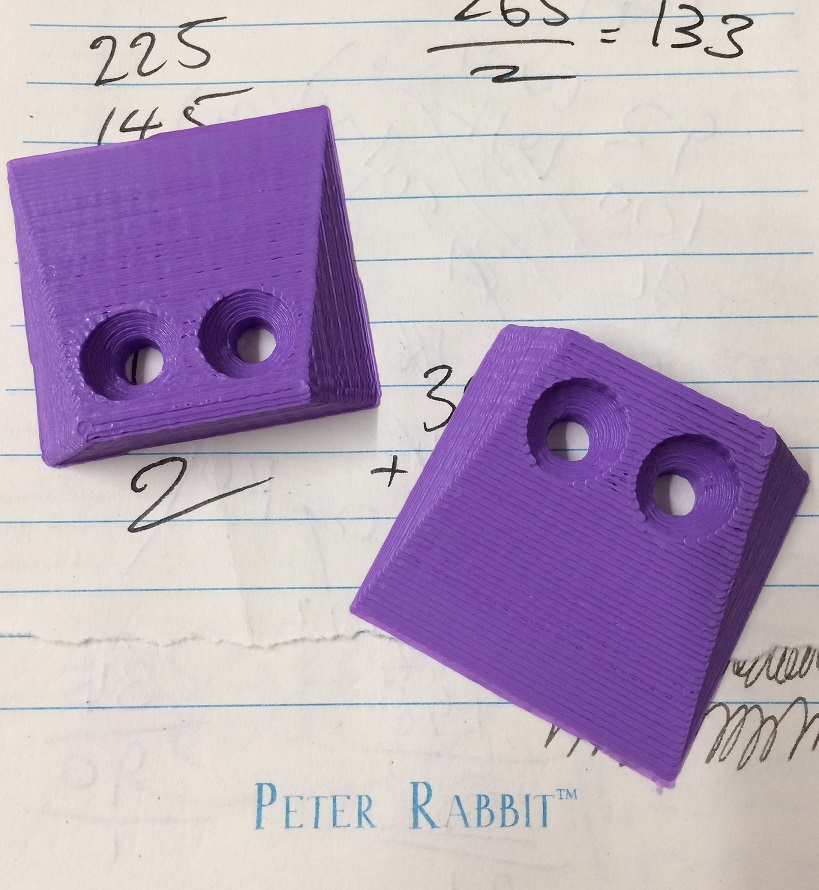
I’ve open-sourced the design and it’s available under the Creative Commons Attribution-ShareAlike licence on Thingiverse. From there you’re able to freely download, print or modify.
If you’ve used this design and it’s saved you time or money then please consider making a donation or leaving some comments on Thingiverse.