3D Printed Precision Trowel Mk.IV ‘Viper’
Design Brief
I wanted to make a precision trowel for metal detecting. When metal detecting, especially on pasture, best practice is to cut a neat plug around a target, of a square shape, leaving the grass on one side still connected – this helps the grass re-grow once you put it back in place.
After cutting a neat plug and turning it over, I then inspect the up-turned plug or hole with a pinpointer and retrieve the find. Without a precision trowel I had to rely on my large spade which could get messy – it was too large for precision jobs. I looked at the cost of off-the-shelf precision trowels but decided to make my own instead. In order for it to be effective my requirements were:
- Strength
- Ability to use alongside a pinpointer
- Minimise chances of scratching finds
- Compatible with the Molle mounting system
I wanted a trowel that was strong enough that I could use day-after-day without it breaking. Obviously it wouldn’t be as strong as a metal trowel if it’s 3D printed in plastic, but with the right use at the right time I was sure I could make it last.
The advantage of printing it in plastic would be that I could use it right up alongside a pinpointer without setting off the pinpointer – which actually really helped!
Another advantage of printing in plastic is that since plastic has a hardness rating which is less than most metal items, it is less likely to scratch finds. The caveat being I still needed to be careful as some finds are incredibly delicate.
When metal detecting I wear a tactical vest with a modular Molle mounting system. This means I can mount all of my equipment for a day’s detecting on the vest, in the right places so that they’re out of the way but still conveniently located when needed. I wanted to make sure that the trowel could me mounted into this so that I didn’t need to keep it in my pocket.
Design Considerations
For precision use I needed the trowel to taper down to a thin point, but thin points are weak, so I needed to reinforce the thin sections.
I wanted the handle long enough for my hands, and short enough to easily slip in & out of the Molle system.
Manufacturing Considerations
PETG or ABS would give me more strength than PLA, but the trowel would also flex more when under load. A flex is nevertheless preferable to a break. Nevertheless I print all of my prototypes in standard PLA since it’s an easy material to work with and doesn’t smell during print.
Printing orientation – I chose to take advantage of the flat base to get a really flat surface on the rear of the trowel.
I used three shell layers for structural rigidity, and set infill at 25% and no support material required.
Early Iterations
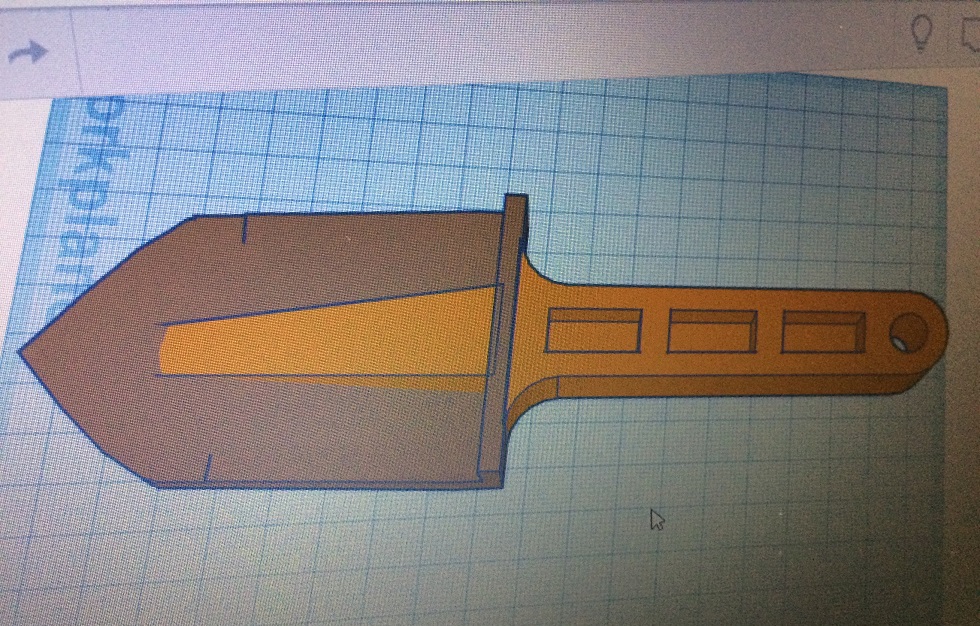
I experimented with various cut-outs and added a circular mounting hole at the top of the handle for a carabiner or clip, so that it can be attached to a bungee. I have a habit of leaving things if they’re not physically attached to me!
Latest Version
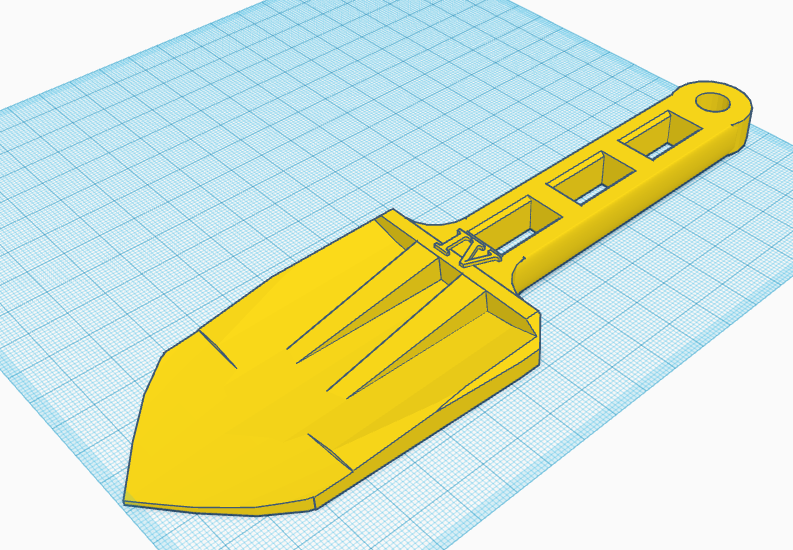
The latest version is Mk.IV codenamed Viper because the tapered supports remind me of fangs. Two support structures run half way down the body of the trowel, I’ve rounded the handle so that it’s more comfortable to hold, added some bevels and adjusted the cut-outs.
This version takes around five hours to print and uses about 32g of material. Dimensions are 60 x 197 x 11mm.
Download and Print it!
Still very much a work in progress, but I’ve open-sourced it so that other people can modify and remix it, and perhaps one day I can print off some remixes. You can download the design from Thingiverse.
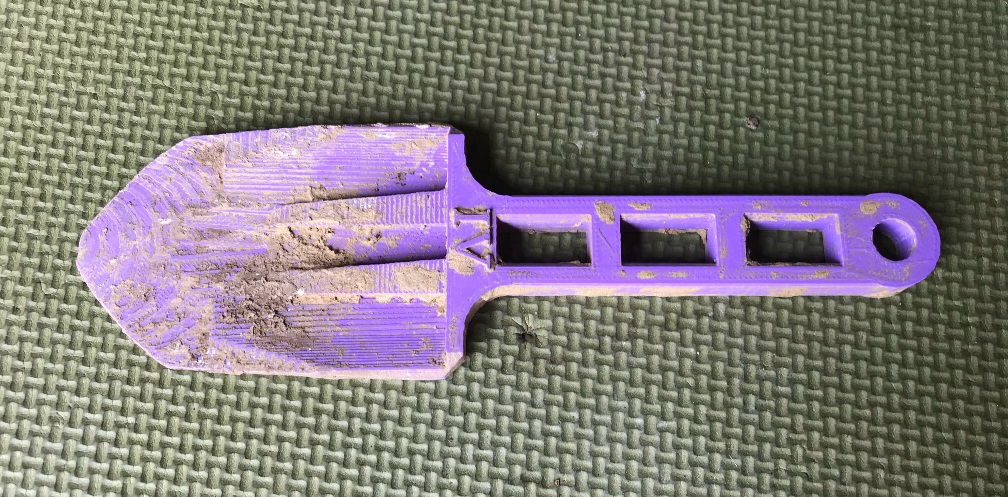
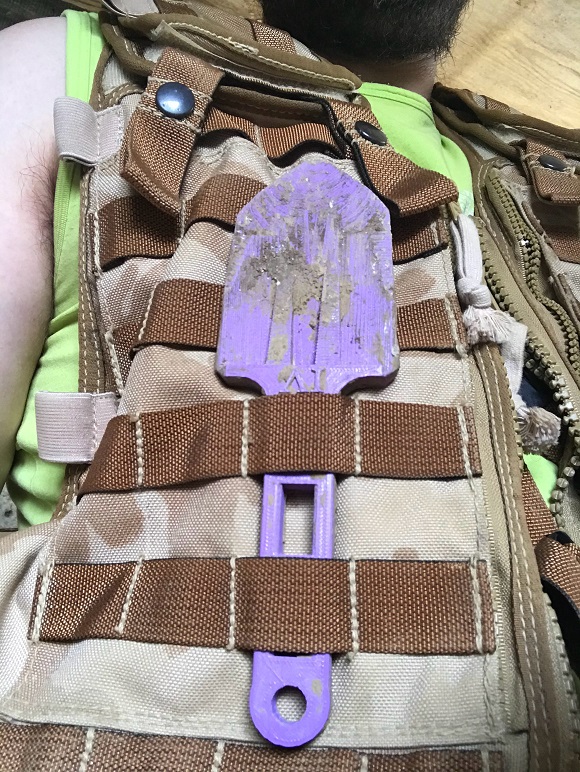
If you’ve made this trowel and found it useful then please consider making a donation or posting a make on Thingiverse.